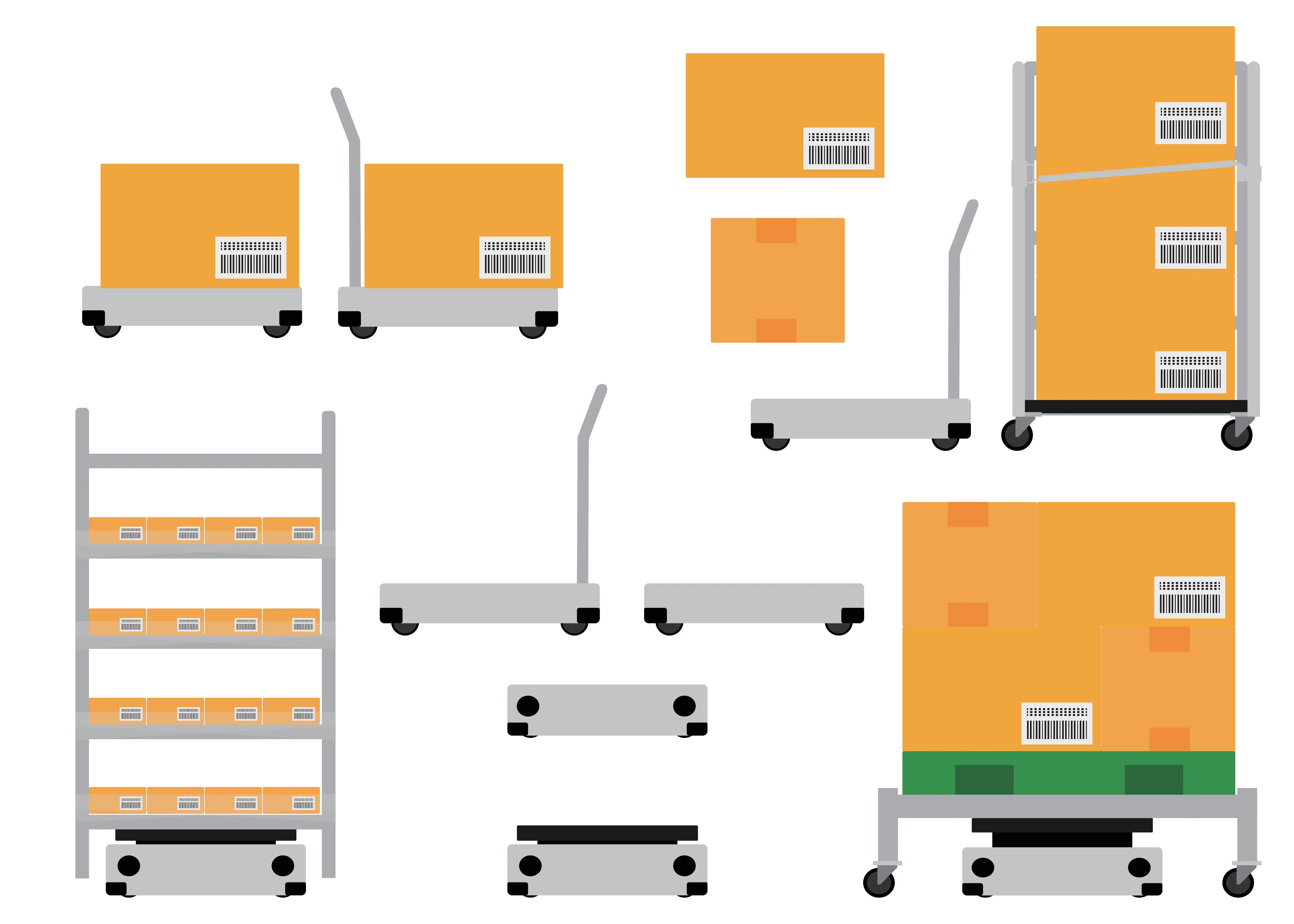
Explained by process! What are the transport equipment and robots that should be introduced to achieve labor-saving in-house logistics?
In the logistics field, there are many tasks that cannot be accomplished solely by human labor in the transportation process, and a variety of machines and robots play a critical role. However, many may be unsure about which type of equipment to introduce and at which stages. In this article, we introduce types of transportation equipment and robots, and the benefits of their introduction.
The concept of transportation process in logistics
In intra-logistics, transportation takes place in various processes such as inbound and outbound handling, storage, manufacturing, and packing. In particular, in the manufacturing industry, it is crucial to streamline transportation between processes. Here we will discuss ""inter-process transportation in the manufacturing field"".
Transportation Between Manufacturing Processes
Processes such as inbound and outbound handling, storage, manufacturing, and packing all take place in different locations, hence ""transportation"" occurs every time the process changes. For example, situations where the target object is installed in a machine tool, or the finished product is removed and taken to the next processing location.
In transportation between manufacturing processes, a large amount of cargo is handled in various forms. However, given the diversity in size and shape of the items, it is not realistic to handle large or heavy objects by hand alone. Thus, various transportation devices are utilized in the logistics field.
Hereafter, we will introduce what kinds of transportation equipment are available.
Types of Transportation Equipment and Robots
There are different types of transportation equipment, including those for safely transporting heavy objects and autonomous robots, each used depending on the purpose. The four main types of transportation equipment are as follows.
Transportation Conveyors
Transportation conveyors are commonly used to handle transportation, especially within manufacturing lines. There are types that move electrically and others that move using human power or the force of inclination on rollers. They can handle straight, curved, and altitude differential movements, and come in various shapes. It is crucial to choose the ideal conveyor depending on the goods being transported, such as pallets and tote boxes.
Elevation Devices
Elevation devices are used to automate the dangerous manual task of moving heavy objects up and down. They ensure high safety and efficiency in floor-to-floor transportation. There are small devices for handling tens of kilograms of objects and large ones capable of transporting a large amount of products at once. They are particularly useful for moving items during storage.
Automated Guided Vehicles (AGV)
Automated Guided Vehicles (AGVs) are robots with wheels that transport objects in place of people. There are types that run along magnetic tape installed in the facility and those that follow a designated route by reading QR codes. There are also various transportation methods such as cart types that carry objects on top and tugger types that tow pallets or baskets. They can help alleviate workers' burdens and solve labor shortages.
Autonomous Mobile Robots (AMR)自律走行搬送ロボット
Autonomous Mobile Robots (AMRs), like AGVs, are robots that carry out unmanned transportation. However, they can autonomously navigate because they have sensors to estimate their own position. Unlike AGVs, they do not require floor work to install magnetic tape, and there is no need to worry about QR codes getting dirty. They can also detect people or obstacles with their sensors and automatically avoid them.
For more on the benefits of introducing AGVs and the difference between AGVs and AMRs, see this article.
Three benefits of introducing transport equipment and robots
There are various benefits to introducing the transport equipment as described above, such as improved safety and labor savings.
Benefit 1: Improved Safety and Quality
By having the equipment replace human transportation work, it can prevent the risk of accidents. The reduction of contact risk is particularly important. In this context, reducing contact risk includes not only preventing injuries caused by contact between people and objects, but also reducing the risk of damage to products and parts. Moreover, in the case of human transportation, the risk of accidents depends on the worker's skill and concentration, but you don't have to worry about such things with transport equipment. By reducing the risk of damage, it also contributes to improving quality.
Benefit 2: Ability to Manage the Movement of Items
In manual transport, it is not possible to completely manage the movement of the items being transported. Also, due to misoperation or loss of concentration, the transport may deviate from the usual route or the transport speed may drop. On the other hand, with transport equipment, it is possible to perform the same work at a set speed. For example, an AGV can fully control its route by following magnetic tapes, and its transport speed is constant, so it can manage the movement of items.
Benefit 3: Solution to Labor Shortage through Labor Savings
Another benefit is that automating the transport process can save labor. In addition to reducing the number of workers, it can also reduce the cost of securing and training skilled workers required for transporting heavy objects or delicate items. Given the labor shortage in the logistics industry due to issues such as declining birthrates and an aging population, introducing equipment to save labor can address the problem of labor shortages and potentially result in long-term cost reductions due to productivity improvements.
In the following article, we introduce ways to improve the shortage of manpower in manufacturing and logistics sites. If you are struggling with a shortage of manpower on site, please take a look.
Introduction of transport equipment and robots from LOGITO
LOGITO, a solution service offered by Daiichi Jitsugyo to automate logistics for companies in the manufacturing and warehouse industries, handles various types of transport equipment and robots introduced, and provides low-cost and customer-oriented total coordination.
Examples of various transport equipment and robots are as follows
Conveyor
We have a lineup of conveyors that can accommodate various types of pallets and totes. We can optimally place straight, curved, merging, and height difference conveyors according to your needs, greatly reducing the time to start up the line.
Elevator Lift
It allows the vertical movement of heavy objects that are dangerous to be handled by humans, and it achieves high standards in transport speed and accuracy. In addition, it is equipped with multiple safety devices, ensuring high reliability for equipment, goods, and personnel.
AGV・AMR
We handle the AMR series equipped with the latest autonomous driving algorithms.
It is suitable for transporting parts and precision equipment in logistics warehouses and manufacturing sites, and customization is possible according to the weight of the product to be transported in your warehouse. Also, because it has a rich record of introduction, it can start operating in a short period of time.
All the transport equipment and robots introduced are connected by software, so system integration is possible.
If you are interested in various transport equipment and robots handled by LOGITO, please view the various catalogs from this page.。
Related Documents
Primer Guidebook for Successful Logistics Automation
In this book, we the current state of logistics automation and examples of failure , and explain the checkpoints to prevent failures in logistics automation.
Leveraging the know-how cultivated through a global network of 34 bases in 17 countries around the world, the LOGITO management office provides a variety of useful information for the practice of logistics automation, from industry trends related to logistics automation to know-how and success stories.
CONTACT
LOGITO is a logistics automation solution provided by DJK.
Singapore
DAIICHI JITSUGYO ASIA PTE. LTD.
SMT Systems Dept.
TEL:+65-6338-3732
1 Kaki Bukit View #04-30/31 Techview, Singapore 415941
We will contact you within one day after receiving your inquiry, excluding weekends and national holidays.
Please be careful to enter correct contact information.